



Geosystem REActive Transport
(GREAT) Visualization Lab
A groundbreaking, worldwide unique laboratory at ETH Zurich investigating reactive fluid flow and solute/heat transport through porous and fractured geological media at high spatial and temporal resolutions.

Specialized Laboratory Rooms & Experimental Facilities
Located in the NW Building (ETH Zurich Campus Zentrum), our laboratory is organized into four purpose-engineered facilities.
Hydro-geochemistry Laboratory
With cutting-edge devices, our research in NW B85.2 focuses on reactive flow-through experiments, precision petrophysical characterization (porosity, permeability, saturation, relative permeability), thermal property measurements (thermal conductivity, diffusivity, heat capacity), and seismic attenuation and elastic moduli of rock samples under in-situ crustal conditions.
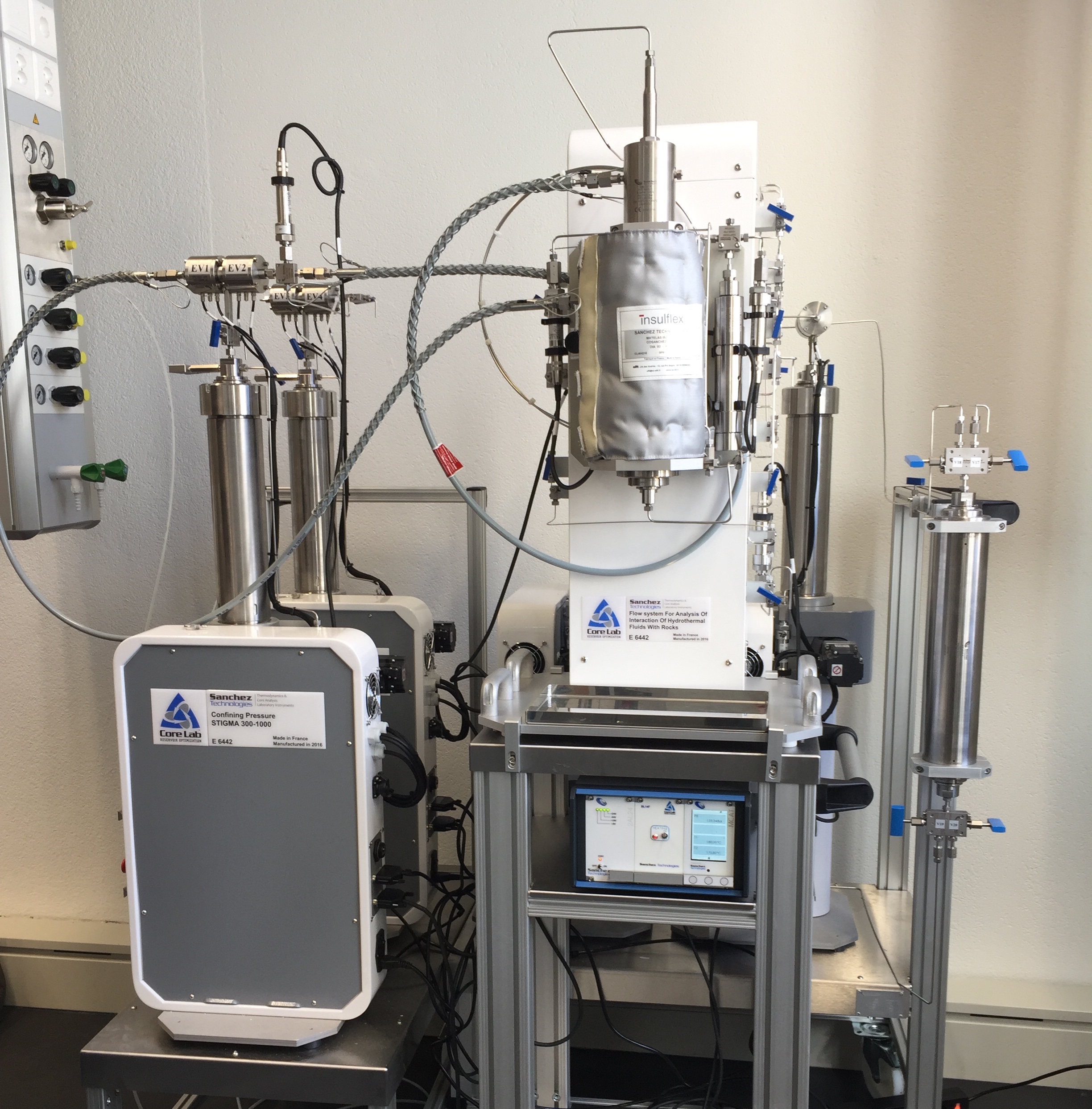
First Reactive Flow-Through System (Sanchez Technologies)
Equipped with a tri-axial core-holder, a double-pump coated with Hastelloy, two single pumps coated with stainless steel, and high-precision heating units. Operates up to 1,000 bar (100 MPa) and 200 °C to study coupled THMC processes in CO₂ geological sequestration, enhanced geothermal systems (EGS), and hydrothermal circulations.
Second Flow-Through System (X-Ray Transparent)
Features an X-ray transparent hydrostatic core-holder, heating unit, water and vapor traps, three phase separators, and precision oven. Operates at up to 1,000 bar and 150 °C, designed for direct radiographic and tomographic monitoring of mineral precipitation, scaling, and dissolution during deep subsurface fluid circulation.

NW B86: Geostudio & XRCT Scanner Facility
Equipped with an advanced X-ray Computed Tomography (XRCT) scanner, financially supported by the SNF REquip Grant Nr. 177031, the Werner Siemens Foundation (Werner Siemens-Stiftung), and an ETH Zurich startup grant.
The scanner delivers nominal imaging resolutions down to 2.5 micrometers for geological and engineered materials. Its distinctive mechanical innovation is a horizontally-rotating gantry supported by high-precision air bearings, permitting in-situ helical imaging during high-temperature and high-pressure flow-through experiments.

Hydrodynamics & Laser Visualization
Equipped with a laminar flow system maintaining an ISO8 cleanroom standard. The laboratory utilizes Particle Image Velocimetry (PIV), Particle Tracking Velocimetry (PTV), and Laser-induced Fluorescence (LIF) to observe pore-scale fluid flow and contaminant transport through transparent fracture and porous media analogues.
Third Flow-Through System (Transparent 3D-Printed Cube)
Consists of a transparent 3D-printed rock cube, a constant-temperature water bath, and modular high-precision pumps. Operates at conditions up to 10 bar and 4 – 75 °C for real-time laser and optical measurement of solute/heat transport, mixing dynamics, and geochemical mineral precipitation.


Geonumerics & High-Performance Computing
Housing our high-end Graphics Processing Unit (GPU)-driven Linux cluster dedicated to rapid volumetric CT image reconstruction, Digital Rock Physics (DRP) processing, pore-network extraction, and large-scale parallel numerical simulations of reactive fluid flow and geothermal reservoirs.
Explore Our Computational and Field Methodologies
Learn how laboratory experiments integrate with computer simulations and field investigations.